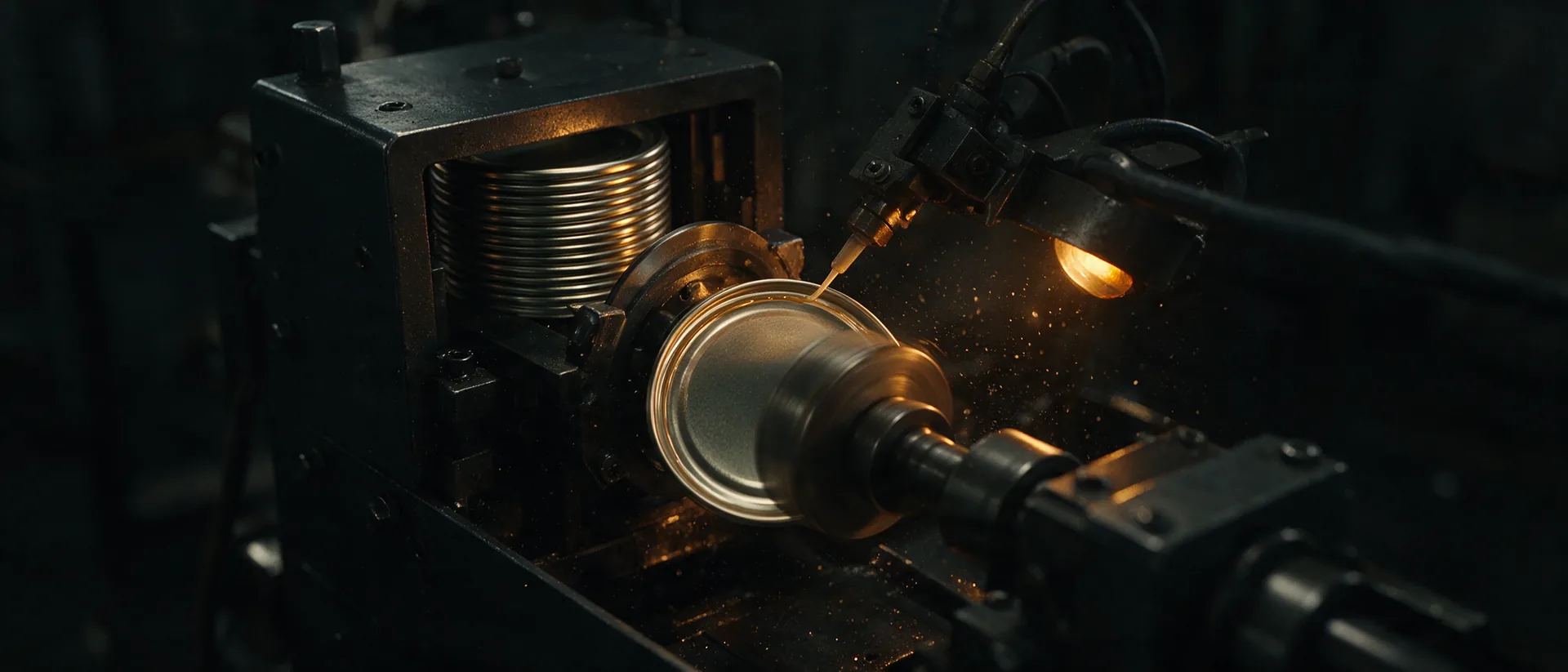
Less sheet scrapped. Less gas burned.
Ends-line modules, scroll shear to curler, liner and oven, installed one at a time beside the presses you already run.
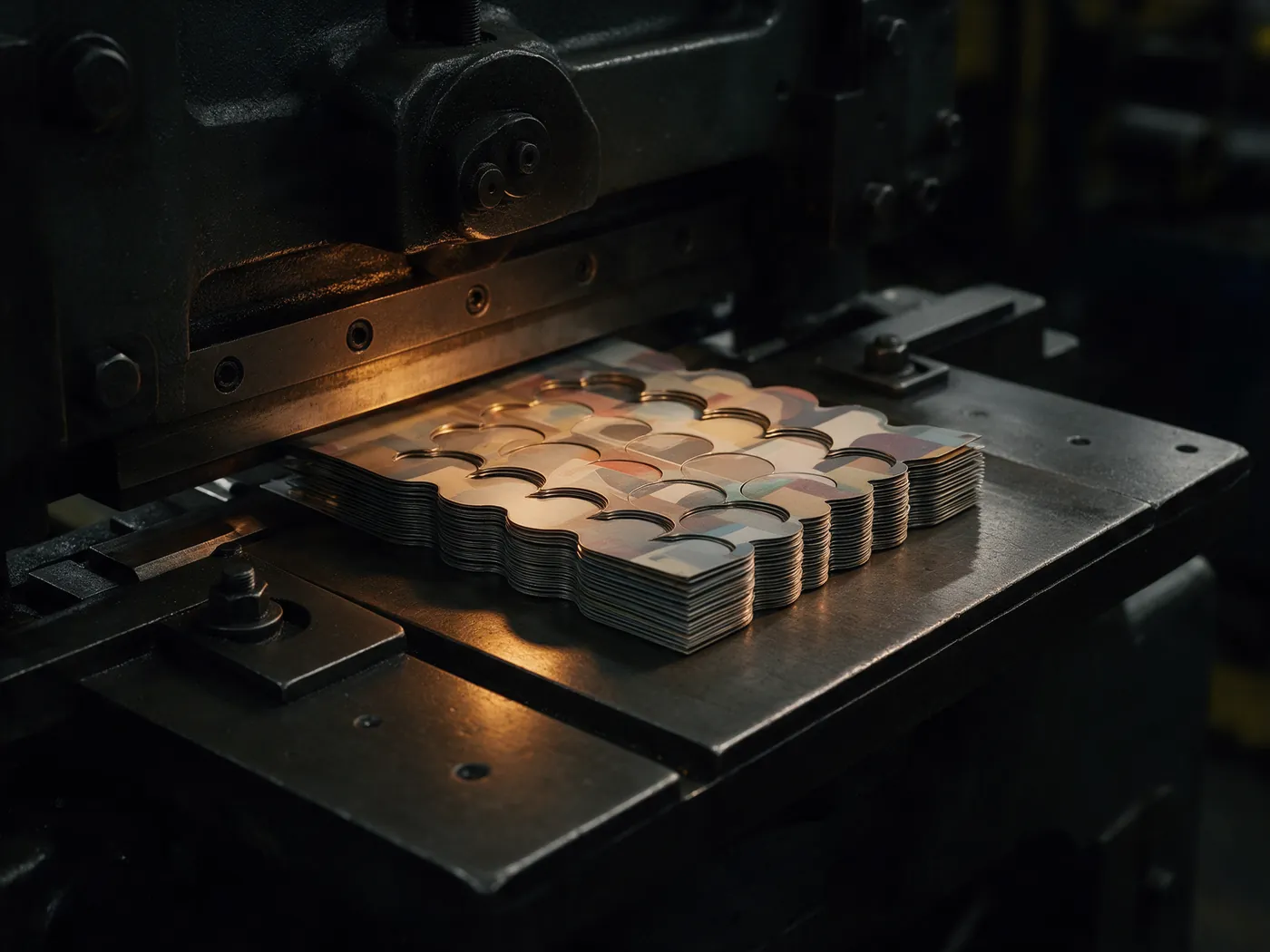
Four places an ends line leaks money.
-
Sheet lost at the shear
A strip that comes off with a burr or off pitch is tinplate you paid for and can't stamp. Carbide blades and fixed-pitch calibrator bars hold the cut to the printed scroll.
-
Strips that stop the press
A doubled strip or a missed feed stops the press and scraps what was in it. The press detects double strips and phases suction cup, scrap ejector and feeders by encoder.
-
Compound that doesn't track the speed
Too much at low speed, too little at high. An electronic nozzle, with machine and mandrel on separate drives, sets compound distribution per production speed.
-
An oven that burns through the size change
Automatic temperature control, flame safety and a size change done on both sides at once cut the time the burner runs without ends passing through.
One module at a time.
Each one runs on its own or feeds the next. Figures are rated capacity from the current catalog, not line output; sizes are in millimeters, and the inch equivalents for your end sizes come with the finding.
Scroll shear CG 422
Carbide blades set in the middle of the toolholder, guided by four roller columns on a rigid block casting. Electronic sheet counter with double-sheet ejection, and gears in an external oil bath for a quick size change.
Strip feed press PDV 394
Double-die press on a casting-block frame, flywheel on the base so the crankshaft carries no overload. Encoder-controlled phasing, double-strip detector, magnetic strip feed from the shear. Camera inspection of the end, inside and out, on request.
Curler CUD 520
Nine-sector modular curling ring with double channel, a crossed-roller bearing under the ring, and inlet belt and ring speeds adjusted independently. Handles DR8 material. A magnetic elevator to the liner and tooling for aerosol ends are options.
Compound liner and vertical pocket oven
Liner with electronic nozzle, compound flushing and separator worms on both sides; oven that carries ends in heat-resistant pockets, with adjustable automatic temperature control and an electronic flame safety device. Single (MT556, FVSTC543) or double (MTD555, FVDTC542). An electric oven is available on request.
Source: cevolani.eu, End Making, current catalog. The liner and oven ratings apply to ends from 40 to 180 mm in the single unit and 40 to 109 mm in the double.
Connects to the presses you already run.
“Easy connection with already existing presses.”
cevolani.eu, Curler, as published. Quoted without edits.
- What it means
The curler is the one module Cevolani rates for hookup to another maker's press. You keep the shell press and add the curl station behind it.
- What follows
Liner and oven take their feed from the curler, with the optional magnetic elevator in between. The three go in as a unit or in stages.
- What we verify
Every other hookup on this page gets checked on your layout during the audit. Nothing here assumes compatibility with equipment Cevolani didn't build.
Honest about the range.
Fits
Cevolani labels its ends series a medium to high production range. Per unit, the press, liner and oven are rated below a thousand ends a minute, the curler at a thousand. Steel and aluminum ends, round, oval or rectangular, and aerosol domes through the oven.
Doesn't fit
If your line runs well past those ratings, we'll say so on the first call instead of booking a visit. That's why the form asks for ends per minute: it decides whether we're a fit before anyone's time is spent.
The catalog publishes no gas or power consumption for the oven. The energy figure on this page is what the audit measures on your line, not a claim about it.
A scrap and energy audit, in writing, at no cost.
The Ends Line Scrap and Energy Audit ends with a finding per module: which number it moves, by what mechanism, and what stays as it is.
You send three numbers
Scrap at the shear and the press, fuel or power drawn by the oven per hour, and die change time, on the one-page capture sheet we send you. A shift lead can fill it in a day.
We read them against the modules
Each number gets matched to the station that drives it, and to the module that touches that station. Hookups to your presses are checked on your layout, not assumed.
You get a written finding
Per module: the mechanism, the scope of work, the downtime window and the inputs for your capex case. If a station should be left alone, the report says so.
Cevolani, Bologna, since 1800
A manufacturer that designs, builds and tests three-piece can and ends machinery at its own plant, and still supports what it sold decades ago. More than 0 machines built, by its own 2021 count.
Every module on this page comes from its current catalog, with wear parts stocked at the factory warehouse.
Crestpack, McAllen, Texas
The North American counterpart for Cevolani equipment, run by Eurotecsa International LLC. The group behind it has integrated packaging lines since 1978, with a U.S. office since 2024.
One contact for the capture sheet, the technical reading and the follow-through, in your time zone.
Tell us your end size and your speed.
Six fields. Put your end diameter and ends per minute in the message; they decide whether we're a fit.
- You'll hear back from a @eurotecsa.com address, not an autoresponder.
- If your speed sits above the range, we'll say so on the first call.
- No newsletter, no drip campaign, and we don't sell your information.